Friday, August 30, 2024

Army Spotlight: Wellington at Waterloo

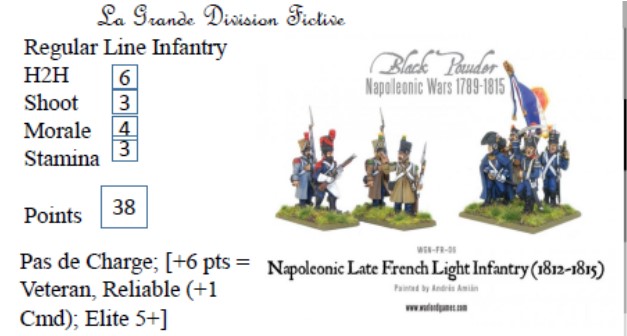
We have another Army Spotlight: Rob's British force, Wellington at Waterloo. This is a 28mm army used primarily for Black Powder games. Rob has both French and British Black Powder armies, but since his Brits are a frequent opponent of my own La Grande Division Fictive, I thought it best to spotlight his British force. I copied my unit stat cards from Rob's concept, his revised cards are included below as well. 

Rob has been kind enough to provide the text for the photos of his army below.

Rob:

My figures are a combination of Victrix, Perry, and Warlord. This whole 28mm Napoleonic thing started when I was at Historicon about 12 years ago and some vendor was selling Victrix infantry boxes for $20 a pop. I got 2 French and 2 British, which was basically half of each army.


Wellington and Uxbridge. I also have Picton from Waterloo, but he was a bastard and he doesn't have his proper uniform, so to hell with him. My other generals are named after fictional characters from the greatest wargaming website of the early 2000's: Major General Tremorden Rederring's Colonial-era Wargames Page

That's Lord Uxbridge in the blue. He's on the wrong horse, as I assembled my officers a little carelessly. I've always been fascinated by the story of his amputated leg.

Wellington and Colonel Bindon Mudd leading the 33rd Yorkshire. Wellington was accidentally glued to Uxbridge's horse, which is saddled with a Tiger Skin. I had assumed that Wellington would get the fancier saddle, but it turns out that Uxbridge was the saddle dandy.


Household Cavalry (Life Guards). When I started with the British, Perry wasn't making these in plastic, so I only bought the Hussars. It didn't take many battles before I realized that I needed them eventually. I originally intended to make them Horse Guards, but since my Hussars were already in blue I wanted the unit to stand out more and so chose the red-tunic'd Life Guards. 


Life Guards once more. I went ahead and decided to make them a unit of 12 mounted 3 per base on... 65mm I think? 70mm?... after I was unsatisfied with the previous cavalry mounted 2 per base on a 50mm. This configuration looks better on the table.


Perry Hussars. There's so much detail on these guys, which made them a pain to paint but they came out well. I have 3 units, 2 of 10 and 1 of 8. You need to look at the Shakos to differentiate them.


British foot artillery. British foot artillery from Victrix. Cheap plastic but sporting lots of detail. Love this kit. I prefer using 2 guns to represent a battery. If I had to do it again, I would probably mount these to smaller square bases, but I think they take up a more realistic amount of battlefield real estate this way. If I had my way, we would use three guns to represent the big Russian batteries.


Chosen men with a casualty marker. There were a couple of riflemen in each box of British infantry sprues from Perry, so of course I had to build the 95th. They are technically a little bit better than the standard rifle company in the rules, but I increased the points cost to bring them into line. I think there were a couple of casualty markers in each box of Perry Hussars. Very thoughtful of them! One of these days, I need to find an appropriate model for Sharpe.


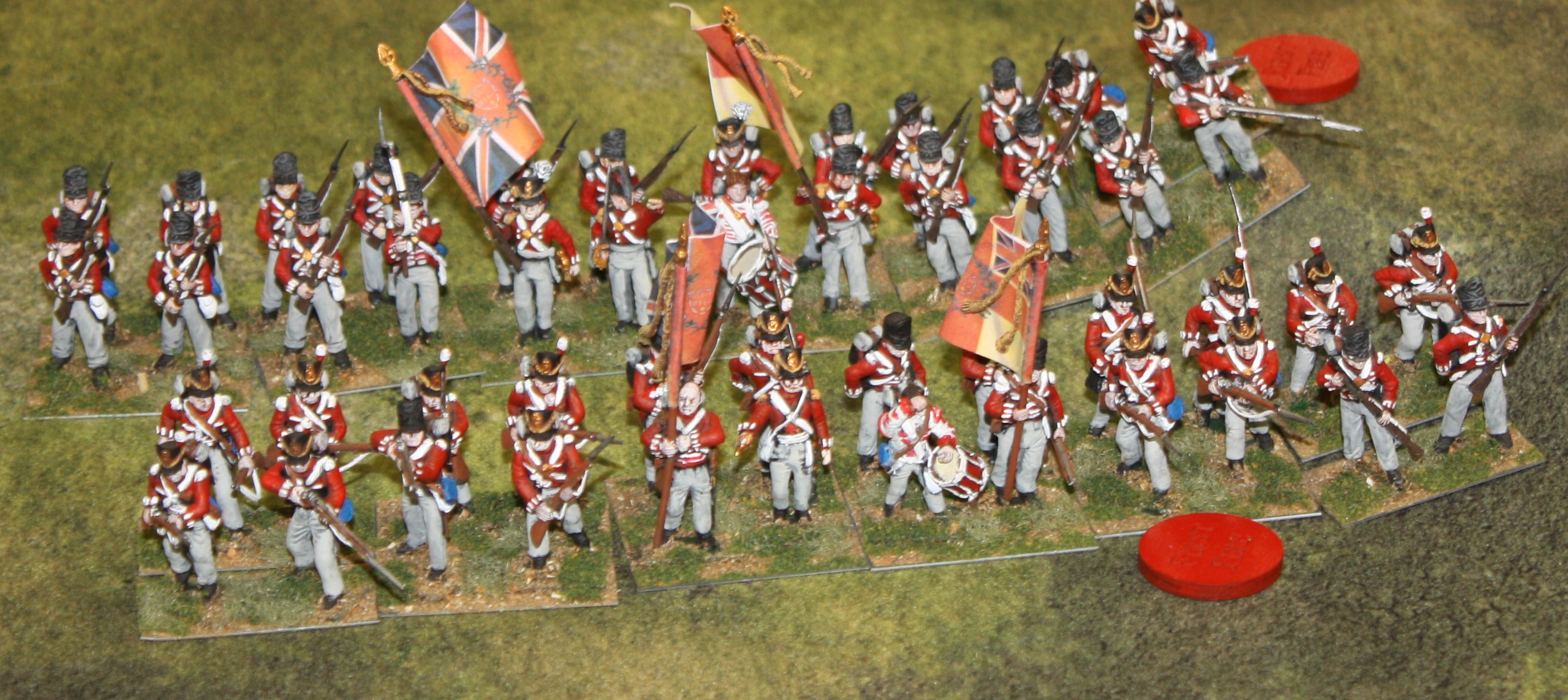
69th South Lincolnshire, 1st (and only) battalion. Units on the British side are differentiated by the color of the collars and cuffs, and also the tunics of the drummers. Technically every battalion should have two flags (one regimental and one union jack). I was originally going to have 36-man units, but decided that was too many at 28mm scale, so the number of command figures got reallocated during painting.


This is the 33rd Yorkshire, 1st and 2nd Battalion. The flags are printed from an inkjet on thick resume paper, then put together with watered down PVA and worked into shape. I should technically paint the edges afterwards to hide the constructions, but that's too much work. The flags were printed from scans of the flags which came with the various kits from Victrix, Perry, & Warlord. Those were printed on glossy paper, however - that's why I did a scan and reprint on all of them.


Soldiers of the 4th King's Own, showing my desultory brushwork. I prime black, then undercoat the flesh brown, then build up a couple of layers of dry-brushed colors. The faces and hands get a flesh wash, then another highlight. It looks good from 3 ft away.

The 4th King's Own, 1st and 2nd Battalions.


Just enough detail on the paints. Bent and broken bayonets are a huge problem with all my Napoleonic figures. It's mostly the Victrix models, which are mostly in more dynamic poses designed for skirmished or single-base figures rather than ranked infantry. If I had to do it over, I would have stuck with the Perry figures.


A rifle skirmishing company from the 44th East Essex flank battalion is set up to screen 2 battalions of the Coldstream Guards. The 44th East Essex uniforms with their yellow collars and cuffs are featured heavily in the Sharpe's Rifles series.


1st and 2nd Battalions of the Coldstream Guards, being led by Major-General Tremorden Reddering. These are Warlord figures. Adding guard infantry to my Brits makes them much more competitive against the French.


Sunday, June 23, 2024

Army Spotlight: La Grande Division Fictive

 This army came about in an interesting manner, at least to me. I never really wanted to build a Napoleonic army, especially 28mm. Too much work, and I wasn't keen on the obsessive uniform study. And it wasn't a period or war I particularly favored. But my son was in his late teens and interested enough that he bought the Waterloo - Black Powder 2nd Edition Starter Set and insisted I take over the French so he would have an opponent. If you are a father you know that you cannot pass up the chance to wargame with your son!

I am not normally a fan of the French, but I knew I had to find a way to make a French army intriguing to me. And that was when I recalled Arthur Conan Doyle's Brigadier Gerard. I immediately began rereading the series and hunting for the stories I hadn't yet read. This foolish French officer gave me the spark I needed. I decided my French army would be "fictitious", it would be commanded only by French commanders taken from literature. Further, it would primarily be cavalry, especially light cavalry. I knew they would mostly perform poorly on the battlefield, but they should be fairly fun to have charge about - quick to advance and quick to withdraw, but always filled with élan!

I soon became as obsessed with uniform details as I had feared! Of course, my figures are far from museum quality, and I didn't get all the details right. I tried to set a good impression viewed from 2-4 feet away. It took me several years as I am a slow painter, but here is La Grande Division Fictive, fresh from their first (marginal) victory!

The generals first. Aside from Gerard, I didn't try to match General figures to their appearances - too difficult. The commander of the division is General Calvet, from Bernard Cornwall's Sharpe series. 


I got these figures cheap at the Historicon flea market, they were a bit dented and bent. They looked familiar and some research revealed they were probably inspired by a painting of Marshal Joachim Murat - see the image below. I painted the figure to the left to match Murat as much as I could. The central figure on the black steed is based on another painting (see below) and the third I painted from imagination. Generally, during play, the brown horse represents Calvet, the black represents Feraud, and the white represents Chabert.

The Equestrian Portrait of Joachim Murat, King of Naples
by Antoine-Jean Gros likely inspired the sculptor
of the figures I use for some of my generals.

Death of Prince Poniatowski on October 19th. 1813 by Horace Vernet
I chose to model the colors for another of the general figures above. 
Since one of my infantry lines is Polish (see below) I chose a Polish Marshal who
fought for Napoleon to base the paint job on But usually the figures represents Brigadier Feraud. 

I tend to run the division with five small brigades now. first Brigadier Gerard's Brigade. 


I have painted Brigadier Gerard as an officer in 2nd Hussars – the Hussars of Chamborant.

He commands a squadron of hussars and a squadron of chasseurs à cheval.


 2nd Hussars led by Brigadier Gerard.


9th Chasseurs à Cheval

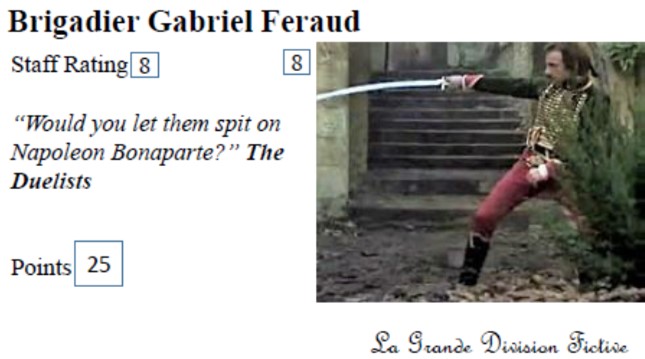
Next, another cavalry brigade. This one is commanded by Brigadier Gabriel Feraud from the movie The Duelists. He commands my heavy brigade, with a squadron of dragoons and another of chevaux leger lancer.


6th  Chevaux Leger Lancers


French Dragoons

The final cavalry brigade comprises two squadrons of chasseurs à cheval (see above for their stat card).
It is commanded by Brigadier Armand d'Hubert, also from the movie The Duelists.


15th Chasseurs à Cheval

2nd Chasseurs à Cheval

I wanted to emulate Napoleon's Grande Batterie tactic, so I created an artillery brigade of 3 horse artillery batteries. It is commanded by Colonel Hyacinthe Chabert from Honoré de Balzac's novella of the same name


Horse Artillery.

The final brigade is the only infantry brigade. It is commanded by Brigadier Guy Loup, also from from Bernard Cornwall's Sharpe series. He has a battalion of Light Line Infantry, and two line Battalions.


Brigadier Loup in front of some of his men. 


To differentiate between them, I use all grey greatcoats for the regular line infantry,
though I know the coats were more varied in reality. 


I use brown great coats for the Light Line infantry, seen here passing behind a cavalry screen.


One of my Line battalions are the Polish Vistula Legion.

So, that is La Grande Division Fictive!

Saturday, June 22, 2024

Battle Report: La Grande Division Fictive versus the British Army

 This past Friday, Rob and I played out a game of Black Powder and we decided to take pictures of each turn and write up a battle report. The game was played usng 600 point armies (using the same point system we employed for the 2023 Fearless Veteran Tournament

I decided to play La Grande Division Fictive, an imaginary division of Napoleon's Army circa 1814/1815 commanded by generals drawn from fiction.  Rob played his British force. 

We chose a simple scenario, our two forces faced off across a notional Western European battlefield, with one third of it divided from the rest by a bridged river, with some few trees, hills, a farm and inn alongside a road. Three objectives (kegs of ale, wine, and food) were placed roughly equidistant from each other along the road, starting in the farmyard, at the bridge, and extending out to inn. 

Looking from the East to the West. On the north the British set up, with the 95th Rifles skirmishing in front of a squadron of Household Cavalry, followed a strong brigade of infantry and artillery on either side of the river, and ending with a squadron of light cavalry. The French set on the south. From East West, a brigade of 2 squadrons of chasseurs à cheval, then a Brigade of 2 Line battalions and one Light Line battalion. Then another cavalry brigade, a squadron each of dragoons and chevaux leger lancers. The French Horse Artillery brigade was divided with two batteries on the east side of the river with the infantry and its third battery across the river with the two squadron's of Gerard's brigade - hussars and chasseurs à cheval. 

The French infantry advanced to the road, while a squadron of chasseurs cantered to the base of the hill east of the farmyard. A few British infantry battalions advanced as well, and the French horse artillery galloped forward, unlimbered and began to fire on the British. 

On the west flank, Brigadier Gerard lead his hussars in a gallant charge against the British lights, who charged in turn, meeting the hussars in a vicious melee just south of the road. 


Though they suffered similar losses, the hussars broke and withdrew through the chasseurs to reform.
The British lights swept through and slammed into the Chasseurs, who broke and fled the field. 

The 95th Rifles charged through a storm of shot to assault French artillery at the farmyard wall. 
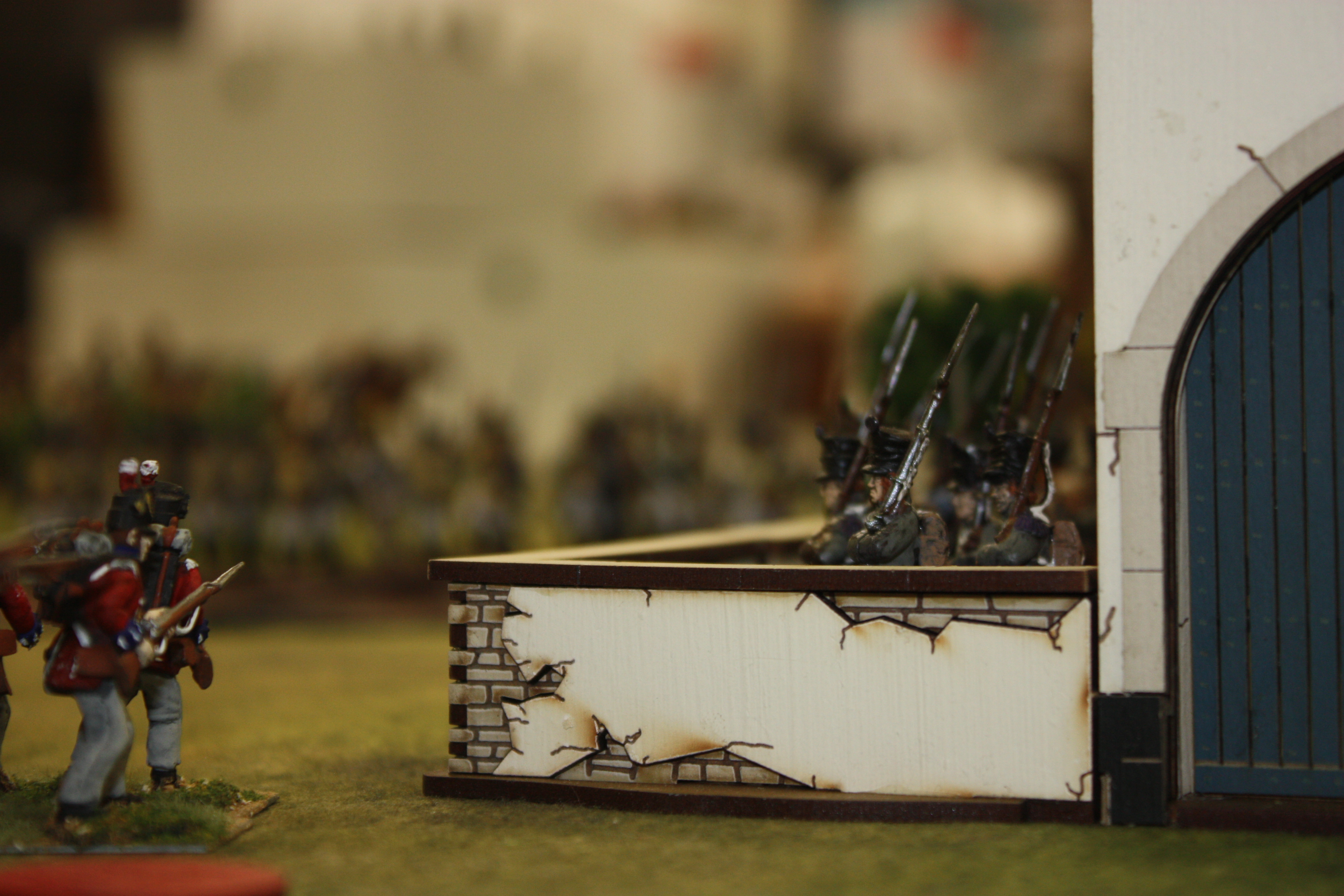
The French artillerists stepped up and fought back hand to hand along the wall against the green-coated riflemen.

The Household Cavalry moved behind the east hill, guarding against French cavalry sweeping around that flank. The French Light Line infantry occupied the farm building, securing that objective. The French lancers charge the foremost British infantry battalion, which formed square and fended them off. The lancers withdrew in good order, and the British infantry resumed line formation. The western French horse artillery battery one its gun duel with the British artillery battery facing it, destroying it. The British light cavalry stands victorious on the far west flank, but the infantry over their dawdles, unwilling to advance. 

Ignoring the infantry, the French lancers charge the British artillery up hill but come up short.

The two French line infantry battalions take a strong position along the road and the farmyard wall.

British and French infantry face off across the farmyard
wall. 

Night falls, ending the battle. The Household Cavalry and the French chassuers in the 
east never came to blows. 

The eastern flank at the end of the battle. The artillerists have driven back the 95th rifles, now they and they light Line infantry hold the farmyard and its objective. The two French line battalsions hold off the British infantry along the road and the wall. 

On the west side of the river, Brigadier Gerard has rallied his hussars. The Horse artillery battery galloped up and delivered a devastating barrage into the flank of the British light cavalry, but British light infantry occupied the inn, siezing its objective and delivering withering fire down into the artillerists. But just across teh river, it can be seen that the bridge objective is held by the French lancers. 

The game ended with a marginal French victory, holding two of the three objectives.  It could have easily swung back the other way of the game had continued, however. 

An excellent, fun game played against a gentlemanly opponent!

In turn one, Rob advances his light cavalry to the road. 


Tuesday, May 7, 2024

Strategos: L'Art de la Guerre at the Richmond Open 2024

Trophy painted by Ren Westermeyer.

On 4 May 2024 I ran a L'Art de la Guerre Tournament at the 2024 Richmond Open.

It was a small,  3 round L'Art de la Guerre tournament. It was a semi-open format, 15mm scale, 200 points\ army lists. Any army from the Ancient, Classical, or Roman period lists in the 4th edition book ADLG book was permitted. 

The tournament was run in a round robin tournament, with 2 hour rounds. First round match ups were chosen at random, for the second and third round the opponents were chosen based on who won in the previous rounds, in order to determine a clear tournament winner.  The winner was determined by number of victories, draws, and defeats. The winner was given a trophy and earned the title "Strategos" of the Richmond Open 2024. 

1st Place / Strategos Walter Burgoyne [#55 Carthagnian] 2 wins, 1 draw

2nd Dutch Adams [#79 Classical Indian] 2 wins, 1 defeat

3rd Jeff Wiltrout [#59 Meroitic Kushite] 1 win, 2 draws

4th Michael Kelley [#109 Sassanid Persian] 1 win, 1 draw, 1 defeat

5th Paul Bellerive [#60 Classical Greek] 2 draws, 1 defeat

6th Lawrence (Alan) Wright [#39 Alexandrian Macedonian] 3 defeats

It was a fun, friendly little tournament, and I think everyone had a great time, and got three decent games of ADLG in. I will most likely run this tournament again next year, hopefully I'll get an odd number of entries so I can play as well. 😀

It has been described, tongue-in-cheek, as the "mean old man tournament" 😄, referencing  the relative age of most ADLG players but honestly, the players were all gentlemen, IMO. 

I award the Strategos trophy to Walt Burgoyne (L).